Who We
Become When
We Talk
to Machines

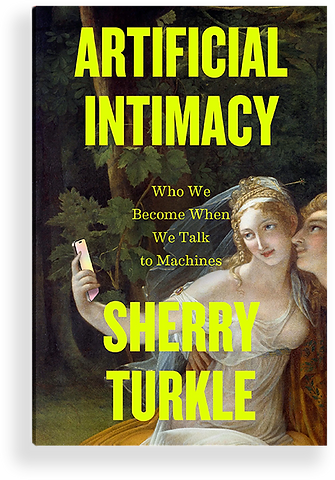
“If social media came for our attention, artificial intelligence
now comes for something deeper:
our capacity for attachment.”

BUY NOW!
Amazon | Barnes & Noble | Bookshop.org | Hachette
REVIEWS

“[Artificial Intimacy] argues strongly that our new ‘posthuman conversational partners’ are inadequate companions for life’s journey…Turkle grounds her analysis in academic literature, while illuminating it with often haunting vignettes.” MORE
―Financial Times
“A gifted writer . . . [Turkle] organizes her book to follow a range of people at every stage of development, from youth through adulthood—people who have, alarmingly, moved beyond engaging AI chatbots for simple conversation or pure utility and come to rely on the technology for emotional succor . . . A strong case for why we should resist the urge to replace human bonds with AI.” MORE
―KIRKUS REVIEW STARRED REVIEW
“Sherry Turkle, who has chronicled our tumultuous relationship with computers, sees “a long-standing fantasy...that AI will offer a perfect companion that knows everything about you. It will be there for you and ask nothing in return.” Her wise new book, Artificial Intimacy, expands on themes she began developing in The Second Self (1984) and sounds an alarm: “We are on a path to forgetting what it is to be human.” More
―James Gleick, New York Review of Books
“Offers something new to current conversations about AI: a heartfelt warning about forming attachments to chatbots…Built on Turkle’s decades of research on technology and human development, Artificial Intimacy unpacks human-AI relationships with care and honesty—two things, she argues, that chatbots will never truly provide.”
―Christian Science Monitor
“Turkle is an elegant writer; she uses the precise and accessible language of someone who has thought deeply and deliberately about her subject, and has followed its changes
over time . . . In her closing pages, she warns that chatbots have been distracting and pacifying us when we need to be ever more engaged in civic life. A.I. has encouraged our descent into 'passivity and post-truth,' she says. The assertion rings terribly true.” MORE
―New York Times, Editor's Choice
“A pointed critique of the growing impact of artificial intelligence on human relationships . . . [Turkle] urg[es] readers to question whether these tools enhance or inhibit personal growth. Harrowing and poignant, this timely warning deserves to be widely read.” MORE
―Publishers Weekly Starred Review
“From grief companions to AI for household tasks, Turkle’s "Artificial Intimacy" is an “urgent warning” about the humanistic traits we stand to lose when we stop talking to our loved ones in favor of computers. This book builds on decades of the author’s research and offers solutions for reclaiming humanity as the tech sector grows.” More
―USA Today
Advance Praise
“All around us, people are beguiled by the siren song of artificial intimacy. Chatbots offer inexpensive therapy, friendship, sexual fantasy, and even romantic love. Sherry Turkle's 40 years of groundbreaking research and beautiful writing make her the most qualified member of Team Humanity to call us back to our senses, and to each other.”
―Jonathan Haidt,
author of The Anxious Generation
“Sherry Turkle, our wisest guide to digital life, has written her most urgent book yet. Artificial Intimacy will help you avoid the profound but often hidden threats AI poses to you and your relationships. Read it and share it with all the humans you know.”
―Nicholas Carr,
author of The Shallows
“A necessary exploration of what happens when we seek the comforts of connection over the demands of relationships. A must-read for anyone engaging with AI today. That just about means all of us.”
―Esther Perel,
author and host of Where Should We Begin
“Our relational nature as human beings is being colonized by machines that cleverly exploit our longing for human connection, simulate intimacy, and ultimately entrain us into a world of pretend ― artificial intimacy. May this book reinforce our commitment to trust and inhabit our analog nature as human beings, and resist wholesale digital capture”
―Jon Kabat-Zinn,
author of Wherever You Go, There You Are
“The best thing I’ve ever read about one of the biggest questions of our time: how will we relate to machines as they become more like us? Sherry Turkle’s book is insightful, emotional, rigorous, and deeply human. Read it cover to cover and absorb its wisdom; don’t, whatever you do, just ask a bot to summarize it.”
―Nicholas Thompson,
author of The Running Ground
“The preeminent sociologist of smart machines, Sherry Turkle, now writes against the techno-utopianism of our time and the promise of frictionless intimacy, chronicling the distinction between virtual and actual human community and connection.”
―MIchael Sandel,
Author of The Tyranny of Merit
“Sherry Turkle is the exact right person at the exact right time to write us this exact book. A warning of what we must protect in our age of AI and a celebration of what it is to be human, Artificial Intimacy it is a love letter to humanity written by a woman of brilliance and heart.”
―Priya Parker,
author of The Art of Fighting
“Artificial Intimacy could not come at a better time as society grapples with how to navigate the AI revolution. It helps us make sense of what this new and rapidly evolving technology is doing to our humanity and what we must stand up and protect. Sherry Turkle’s wise words of caution and counsel should be read by those developing AI and all who use it.”
- Vivek Murthy,
MD, MBA. 19th and 21st Surgeon General of the United States.
Artificial Intimacy:
Who We Become When We Talk to Machines
By Sherry Turkle
From the author of prescient best seller and classic Reclaiming Conversation, Sherry Turkle, comes an urgent warning about how our ever-increasing reliance on human-like AI chatbots is eroding our capacity for empathy, caring, and the very qualities that make us human.
If social media came for our attention, artificial intelligence is now coming for our capacity for attachment. Chatbots that speak to us in a human voice offer themselves as best friends, lovers, and psychotherapists. As of 2025, over 70% of teens and nearly one-third of US adults rely on AI for companionship and emotional support, with many preferring these chatbot relationships over human ones.
When we talk to chatbots in these roles, as intimate machines, we accept as sufficient what machines can offer: the mere performance of intimacy, empathy, and love. We begin to think that pretend empathy is empathy enough. We redefine human capacities for care, solitude, and intimacy in terms of what machines can do. Sherry Turkle, the psychologist who pioneered our understanding of human-computer relationships, calls the new culture of chatbots artificial intimacy,our new AI.
Sherry Turkle
Sherry Turkle is the Abby Rockefeller Mauzé Professor of the Social Studies of Science and Technology in the Program in Science, Technology, and Society at MIT, and the founding director of the MIT Initiative on Technology and Self. She is a specialist in how technology changes us psychologically and socially.
Her new book is on our relationships with chatbots —Artificial Intimacy: Who We Become When We Talk to Machines. It will be published by Little, Brown and Company on September 29, 2026. It captures the seductive, beguiling nature of our new faux companions, tracing their effects throughout a human life—from childhood to parenthood, from work to love and more. She warns that these machines are quietly reshaping us - teaching us to avoid risk, sidestep difficult conversations, deny grief, and relinquish skills that make us human: empathy, resilience, the ability to navigate uncertainty. MORE
.png)
Sherry Turkle in the Media
NYT Ezra Klein Show:
Is It a Relationship if No One’s on the Other Side?
MORE


On with Kara Swisher:
How Your AI Companion is Rewiring Your Brain. MORE


TIME | Charter:
How to Maintain the ‘Heartbeat of Work’ in the Age of AI. MORE

New York Post |
Andrew McDiarmid:
The newest tech threat parents need to protect their kids from has arrived MORE

Sherry's Recent Thoughts

THE WASHINGTON POST:
AI claims it can resurrect the dead. I tried it.
Grief and technology is a classic combination. But it’s also playing with fire.
READ MORE

ATLANTIC:
The Original Sin of AI
The harms of chatbots are clear enough to do something about them now.
By Sherry Turkle
READ MORE