Who Do We Become When We Talk to Machines?

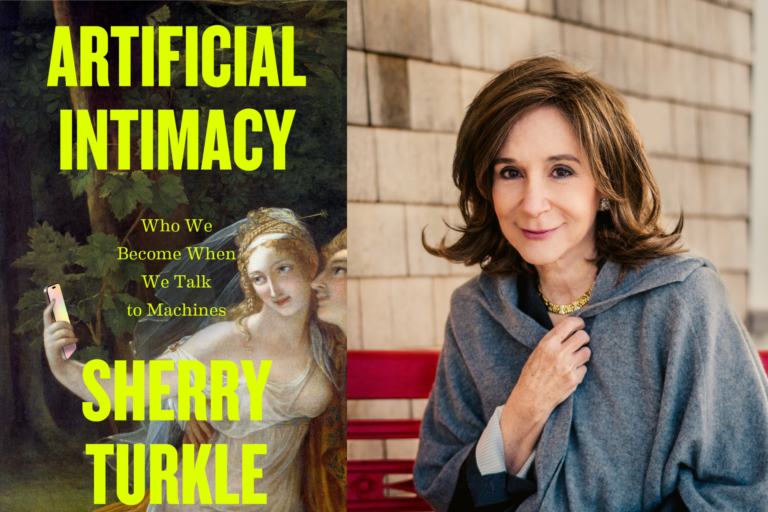
Sherry Turkle in conversation with Audrey Borowski. Leverhulme Centre for the Future of Intelligence, University of Cambridge, UK, June 10, 2024. Streamed by The Philosopher (www.thephilosopher1923.org).

Technology is the architect of our intimacies. We are human because language makes us so. And yet, we now contemplate a world where from our earliest years we talk to smart machines. Machines have no friendship to offer, and yet we persist in the desire for conversation, companionship, and even communion with the inanimate. What does that do to who we are as humans? What do we forget when we talk to machines? How can we remember ourselves?
Sherry Turkle is the Abby Rockefeller Mauzé Professor of the Social Studies of Science and Technology in the Program in Science, Technology, and Society at MIT, and the founding director of the MIT Initiative on Technology and Self. Professor Turkle received a joint doctorate in sociology and personality psychology from Harvard University and is a licensed clinical psychologist. Professor Turkle writes on the “subjective side” of people’s relationships with technology, especially computers. She is an expert on culture and therapy, mobile technology, social networking, and sociable robotics. > Watch Video

I always appreciate websites that make everyday tasks easier without requiring complicated software. Having several practical resources in one place can save time, especially when you only need a quick calculation, a simple document adjustment, or a small image edit. Free Online Tools can be very convenient for this kind of work.
This post resonated deeply with me, especially the idea of how conversational technology shapes our identities. I’ve found myself using tools like foodle to connect over meals online, but I wonder—do you think this kind of interaction diminishes our real-life experiences? How do we balance both worlds?
Reading a review that focuses on concrete benchmarks rather than subjective impressions is refreshing. This page provides an in-depth look at the assistant's memory usage, startup time, and how it stacks up against similar projects like OpenClaw and NanoBot. It also touches on feature completeness, which is often the weak spot for ultra-lightweight tools. To see whether the performance claims hold up, the assistant's measured performance and feature breakdown is worth examining.
Not every calculation requires complicated software. A Free Calculator can be useful for students, office workers, or anyone who occasionally needs to check numbers. Having quick access to one online saves time and makes simple calculations much easier during everyday activities.
I appreciate that this discussion goes beyond whether technology is useful and fnaf asks what it does to us psychologically and socially. That seems like a much deeper question as AI becomes part of everyday life.